|
The MoA Week In Review – OT 2019-51
Last week's posts at Moon of Alabama:
Last night Saudi Arabia bombed a Houthi run detention center in Yemen's southwestern province of Dhamar multiple times. Over 60 people were killed. The prison was registered with the International Red Cross and had been visited by ICRC staff. The Saudis knew exactly what it was. Similar Saudi attacks on prisons took place in December 2017 in Sanaa and in October 2016 near Hodeidah port. Most of the prisoners were on the Saudi side of the war. Why did it kill them?
There are murky reports that several thousand Saudi proxy forces and Saudi special force are under siege north of Kitaf in Sadaa province in north Yemen: Mansour Hadi’s forces in north of Kitaf are still under siege by Ansar Allah and heavy engagements continuing – ISW News
As predicted the unilateral ceasefire ended after the strike. Syrian army artillery shelled some 'rebel' positions. Air attacks have not yet resumed. The Russian military smartly denies that it knew of the U.S. attack.
Other issues:
Loser of the week: Bretbug Stephens and everyone working for the New York Times. – LA Times / WaPo
The Epstein saga continues to make waves – at least in Britain. Peter Mandelson ex-Labour minister pictured shopping with Epstein 2005 – Daily Mail
The Taliban are winning in Afghanistan. Trump wants all U.S. troops out of there before the defeat becomes obvious. John Bolton is trying to prevent that. The welcome result: Bolton sidelined from Afghanistan policy as his standing with Trump falters – Washington Post
Israel is getting nervous: Israel is hiding its soldiers and Hezbollah is winning without firing a shot- so far. – E.J. Magnier.
While I wrote the above antitank missiles fired from Lebanon hit an Israeli military target. The expected strike was in retaliation of Israel's recent killing of two Hizbullah personnel in Syria and its drone attack in Beirut. Will Netanyahoo escalate and start a war to win his reelection?
Use as open thread …
@james #56:
thanks for the overview on the other currencies… any conclusions off it?
Well, the Swiss (+334% vs US$ since August 1953), Japanese (+239%), and German (+137%) currencies have been great for physical cash savers, while the American (0%), French (−41%), British (−56%), and Italian (−64%) have not. Since ordinary people keep their money in banks, to build a true rating of “saver-friendly” currencies one would need to use the data on average checking account, savings account, and fixed-term deposit interest rates in these countries since August 1953. I don’t know if such data is available. In the same period, gold grew +4240%, S&P 500 with dividends reinvested grew +86125% (the actual real-world growth would have been lower because of capital gains taxes).
since you have access to these charts,
Everybody has access to these charts. Go here and choose any currencies you want to build a comparison chart.
i think you would really enjoy that video grieved shared and which i have also linked to in this post…
Thank you, I’ve already seen it. It’s an excellent documentary and should be required viewing not only for every economist, but for everyone, period. So many things just “clicked” when I first discovered Werner’s writings via ZH. I always understood intuitively that planned economies were better (at least, for developing countries), but my university professors and various Russian economic “experts” gaslighted me by repeatedly extolling the achievements of “free-market economies” of West Germany and Japan. Turns out, Japan was not a free-market economy, but a planned economy, with the planning implemented through credit quotas decided on by a central authority (“window guidance”). Japanese planned export-led economy was such an efficient model that it had to be dismantled to maintain U.S. Empire’s dominance. In Germany, 80% of banks are community banks, which give out loans (=create money), first and foremost, to develop local economy, with profit maximization being a secondary consideration. Again, this is too efficient and has to be dismantled.
Posted by: S | Sep 3 2019 2:04 utc | 103
@Hmpf #64
Do you actually understand what either scenario and respective papers are saying?
Actually, I do. I’ve looked, in considerable depth, into most of the alarmist issues.
Let’s address these topics you raise.
Iro CO2 levels – acidification (Henry’s Law)?
First of all, acidification is incorrect. The ocean is not going to be acid regardless of the level of CO2. Here’s some actual data on “acidification” of the ocean from 1987 to 2014. Note how pH went from 8.11 to 8.07 even as CO2 levels went from ~350 ppm to 411 ppm (data here)
The definition of pH: under 7 = acidic. Over 7 = basic.
8.11 to 8.07 is less basic, but it is not acidic. More importantly, just how big a deal is a 0.04 change in pH? To put this in perspective, scientists believe pH levels were down around 7.42 to 7.92 – a long, long way below the present “decreased basicness”.
What were the CO2 level in this period (The Paleocene Eocene Thermal Maximum or PETM)? 2000 ppm subsiding to a “steady state” of 700 ppm.
If we were to burn all of the fossil fuel reserves known, in the next year or 3, we still might not achieve 2000 ppm.
But more importantly, the PETM was about 55 million years ago. Corals became common about 100 million years ago. They survived the PETM, because they’re around today.
Incidentally, while the PETM was warm, the EECO was not. And ocean pH levels were lower in the EECO than the PETM because the low pH levels in the PETM were primarily due to other reasons.
Iro acidification – food chain?
Food chain – I presume you mean the marine food chain. Well, the PETM was one of the most biologically diverse periods in Earth’s history. Yes, species died out, but far more new species were created. Here’s a graph of biodiversity. Remember, PETM was 55 million years ago…
Iro temperature rise – melting glaciers and ice caps?
The 1 meter rise noted in the original post covers the melting glaciers and ice caps.
I would note that it is well accepted that the Arctic ice mass is a function of oceanic currents and winds – that’s why the “no more ice in the Arctic” predictions have failed miserably.
Ocean levels are a function of overall ice mass: north and south both but south matters more because ice floating on water doesn’t affect sea level much regardless of melt (ice is less dense than liquid water).
While Antarctic ice has been decreasing overall – it is very noisy since there was a record Antarctic sea ice extent in 2015 according to NASA.
From the article:
Zwally’s team calculated that the mass gain from the thickening of East Antarctica remained steady from 1992 to 2008 at 200 billion tons per year, while the ice losses from the coastal regions of West Antarctica and the Antarctic Peninsula increased by 65 billion tons per year.
Iro melting ice – rising water levels + negative thermal expansion toward 4°C?
I didn’t say this above because I saw this coming. The reason so much focus is placed on the Western Antarctic by alarmists is because it is losing mass. However, the Eastern Antarctic is gaining mass.
Most importantly, while overall loss is 58 Gt +- 16 Gt/year, the “acceleration” is 14.6 Gt/year +- 12.9 Gt/year. In other words, we don’t actually know if the acceleration is that strong.
Note what the article said above: from 1992 to 2008, overall the Antarctic gained ice mass of 135 Gt/year. At present rates, the Antarctic ice mass will return to where it was in 1992, in 2045.
The last word: the total Antarctic ice mass is 26.5 million Gt. Wiki estimates that if this all melted magically, it would increase sea level by 58 meters. In order for that to happen by 2100, Antarctic ice mass loss would have to increase 456000 times faster. Not going to happen.
Even for 1 meter of rise solely due to Antarctic ice mass loss at present levels, the loss would have to increase 7877 times faster.
No evidence whatsoever of this happening, even if the absolute worst case acceleration (i.e. present rate with full worst case error bar) occurred.
Iro negative thermal expansion – potential medium to long term effects on rising water levels?
I’ve already expanded at length just how little credibility the higher sea level rise “projections” are from the Antarctic ice mass change.
Here’s a graph of historical sea level rise with the “projections” added on.
Sea level rise has been extremely steady before and during the present CO2 explosion. There is zero evidence to date that it is accelerating in any way, which is why the “projections” keep pushing out the date at which the acceleration will occur. We’re not talking a year or 5 – we’re talking 30 years now that the projections have been wrong.
A longer graph shows just how little rise there has been for literally thousands of years, from a historical basis.
Note that I’m not saying the alarmists are 100% wrong. What I’m saying is: By their own projections and words, their predictions have been wrong for 30 years and counting. Nor is there any evidence that sea level rise, acidification, whatever is actually either going to be bad or is accelerating.
At which point does it become clear that these people don’t have credibility?
Lastly: thermal expansion. I didn’t bother addressing this earlier because all of the studies already account for this. However, to answer your question: water is at its most dense at 4 degrees C. That means it occupies the least volume. In order for thermal expansion to really matter, it means the ice at both Arctic (in winter) and Antarctic period will have to melt and significantly increase temperature above 4 degrees C. That isn’t going to happen, period – the actual behavior is so far removed from this possibility that a huge meteor striking the South Pole and ending life on Earth is more likely.
catastrophic ocean acidification, catastrophic thermal expansion, catastrophic sea level rise – all of these are pure alarmism.
Posted by: c1ue | Sep 3 2019 8:29 utc | 111
@retiredmecheng #141
1. You postulate “off-spec” materials could be a factor? Can you reference any other similar building collapses (north America, same vintage) where this was an issue? Were you thinking that the columns were made of ceramics and not structural steel? I sense a bit of “confirmation bias” on your own part.
Read this report by KLGates – a huge multinational law firm – on the ways in which the construction industry is corrupt.
In particular:
5. Cost-cutting on building materials There is always a risk in construction projects that sub-standard construction material will be used in order to cut cost on buildings. This is particularly the case where there is bribery and corruption, which diverts the funds otherwise available for sourcing materials to line pockets. This may then lead to a knock-on effect through the use of bribes to health and safety personnel in order to approve defective or poor quality materials.Following the Sichuan Earthquake in 2008, it was alleged that local government and construction companies had been responsible for the poor construction of schools in the area. Allegations surfaced that civil engineering standards had been ignored, poor quality materials had been used and the surplus funds had been pocketed.
This has happened all over the world – Japan, Europe, the US, South America as well as China.
2. The expected temperature range in “office fires” is well known. The extent of the fires in the building was estimated by NIST, and can be independently estimated by photographic evidence. At no time were the fires active on all floors. At the time of the collapse, there is no photographic evidence that the fires were “out of control” – to where all/most of the structural steel columns could fail near simultaneously on all floors. Not even close.
I am confused – are you saying the NIST said the fire temperatures were too low for their own estimated cause of failure? So the NIST is contradicting itself? As for external evidence of “out of control” – I am unclear as to what you expect to see vs. what was seen. Either there were fire control systems, or there weren’t. If there were, then any fires would be minimized in spread and extent. If there is fire and no fire control, then it is – by definition – out of control.
Be more clear what you’re trying to say because I have no idea what you’re trying to communicate.
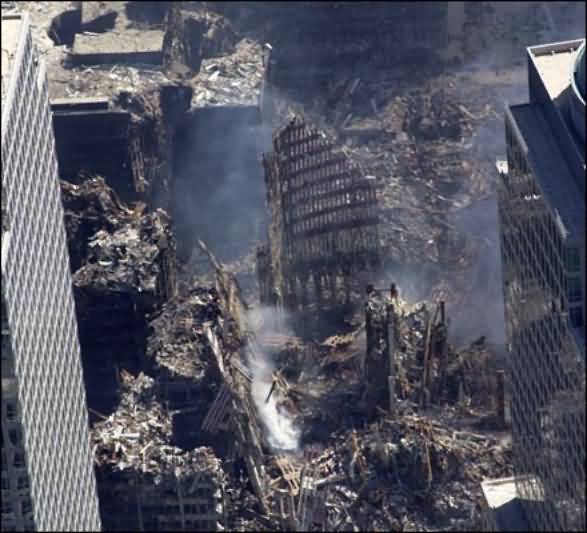
3. The observed collapse (including portions at free-fall acceleration – see the videos) is the most damming evidence that “fire-induced thermal expansion” cannot bring a structural steel building down in the postulated manner.
The “free fall” narrative is by morons. WTC7 weighed around 288,000 metric tons. One metric ton of concrete, dropped from any height, has effectively zero air resistance = “free fall”.
100,000 metric tons – let’s assume is the weight above floor 20 – would also fall at “free fall” unless the steel structure collapsed in stages, which the NIST report did not state. Can a cell phone or consumer digital camera video taken from probably a thousand feet plus feet away show a 6 inch fall in the first milliseconds being slower than “free fall”? Extremely doubtful – and that’s the only point where “non free fall” speed would occur.
Once structural failure occurs, the 100,000 metric tons would fall at the speed of gravity = “free fall”.
Whether you believe in a progressive catastrophic failure (NIST) or a demolition job, the effect is visually identical from the outside except for those first few milliseconds.
As for no other steel buildings collapsing due to fire: again, bullshit.
Here’s a list of publicly known examples of steel frame buildings collapsing – both before and after 9/11 (5:44 into the video).
Another great example: A Dutch TV tower – the spike literally bisecting and falling after a fire.
When I first looked into this, years ago, there was another Dutch building – steel frame – which had a fire on the lower floors and which collapsed catastrophically. That one was only 11 stories or so. Can’t find the video anymore as all mentions of it are overtaken by a more recent 2008 Dutch building fire.
Your lack of curiosity, and quick defense of the indefensible, says a lot…
Your lack of understanding of basic physics – when large masses are involved – says a lot.
You clearly have a predilection for the conspiracy; what I have not seen is any original analysis of your own. Reading other people’s analysis doesn’t replace your own; as you self identify as a mechanical engineer – you have the training and tools to consider the subject without reading anyone else’s “work”.
Posted by: c1ue | Sep 6 2019 15:03 utc | 177
|